by Uncle John | Mar 23, 2025 | The Art of Rattan & Wood
(Or: “Well, That’s a Learning Experience” in Disguise)
Now, I’m not saying you would make any of these errors. But other people — let’s call them “enthusiastic but occasionally slapdash types” — have, and it would be rude not to benefit from their brave and often glue-covered sacrifices.
Mistake 1: The Wrong Glue (a Tragedy in Two Acts)
Act I: You grab the nearest yellow wood glue and happily slather it on.
Act II: It dries a radiant mustard colour and shows through every single open hole in your cane pattern like a grid of fluorescent regret.
Avoid this by:
- Using a clear-drying glue (white PVA is your pal).
- Sparing the glue. If it’s oozing out, it’s not bonding — it’s panicking.
Bonus sin: using permanent glue in a cane groove (e.g. for pressed seats). One day, someone will try to replace that seat and curse your name with quiet intensity. Use hide glue or another reversible option when future-proofing matters.
Mistake 2: Over enthusiastic Stapling
It starts with one. Then another. Then suddenly, you’ve created a staple-based security system capable of withstanding small earthquakes.
Problems include:
- Cane splitting
- Frames cracking
- You running out of staples and hope simultaneously
Solution: Staple every inch or so. That’s plenty. You’re securing a decorative panel, not defending a castle gate.
Mistake 3: Pulling Cane So Tight It Files for Divorce
We all want that nice, taut finish. But if you pull the cane tighter than your last pair of jeans from the before-times, you’re just asking for trouble.
Natural cane shrinks as it dries — that’s the magic. If you start tight, it ends up tighter. Too tight = snapping, warping, or your frame sighing softly and giving up.
Tip: Just snug it. Not “tug-of-war,” more “firm handshake.”
Mistake 4: Soaking for Hours (Cane ≠ Pasta)
Yes, natural cane likes a bath. But leave it in for hours and it turns to mush. At best, you get wobbly, colour-shifted strands. At worst, it’s like trying to upholster with cooked linguine.
20–30 minutes in warm water is your golden zone. Enough to be flexible, not so much it forgets who it is.
Mistake 5: Cutting Too Close
Cutting your cane flush with the frame before securing it is like trimming your hair before it’s dry — optimistic at best, deeply unfortunate at worst.
Always:
- Leave extra margin.
- Trim only once it’s attached and dried.
- Remember that cane patterns unravel if you get too snippy.
Mistake 6: Forgetting to Align the Pattern
Yes, cane has a pattern. And no, it doesn’t look charming when it’s running diagonally across your project like it’s trying to make a break for the border.
Before attaching, lay it out. Center it. Align the weave to something — anything. Your sanity will thank you every time you walk past it later.
Mistake 7: Skipping Sealant on Outdoor Projects
If you lovingly attach natural cane to an outdoor bench and leave it bare in the rain, you have, in essence, made a biodegradable sculpture.
Seal the cane. Seal the wood. Use rust-proof fasteners. Or just use synthetic and smugly skip this paragraph.
Mistake 8: Gluing Your Fingers to the Trim
It happens. We’ve all emerged from a workshop session with a thumb that is 40% more adhesive than skin. But try, if you can, not to finish the piece with those fingers. Glue prints are forever.
by Uncle John | Mar 22, 2025 | The Art of Rattan & Wood
(Or: How to Keep Your Rattan From Turning Into Regret Over the Next Decade)
You’ve done it. The rattan is attached, the glue is dry, the trim is on, and you’ve finally stopped finding cane fibres in your tea. Your furniture looks so good it might start giving the rest of the house ideas.
Now the trick is to keep it that way.
For Indoor Furniture: Dust, Dryness, and the Occasional Existential Crisis
Indoor rattan doesn’t need much, but it does need consistency. Much like a cat, or your favourite barista.
Your enemies:
- Dust (gets in the holes)
- Dry air (makes cane brittle)
- Direct sunlight (bleaches cane until it looks like a ghost of itself)
Your allies:
- A soft brush or vacuum with a brush attachment
- A slightly damp cloth (never a wet one — rattan is a fan of gentle metaphors, not soaking)
- A humidifier in winter if you live somewhere that dries out like a biscuit left on the radiator
Optional heroism: Once or twice a year, wipe the cane with lemon oil, boiled linseed oil, or something equally dignified. This keeps it supple and gives it the kind of glow normally reserved for smug skincare influencers.
For Outdoor Furniture: The Weather Is Coming
Outdoor cane furniture is a tale of courage. Unless it’s synthetic. Then it’s more of a smug shrug.
Natural rattan outdoors?
- Needs sealing. Multiple coats. Think spar varnish or marine-grade finishes. The kind of stuff you’d put on a boat or a very paranoid picnic table.
- Must be kept under cover when possible. Porches: yes. Garden path with no roof: no.
- Regular checks for mildew, sun damage, or insects who have decided your chair is a fixer-upper.
Synthetic rattan?
- Hose it down.
- Wipe it occasionally.
- Laugh in the face of UV.
Still, even synthetic should be cleaned now and then. Use soapy water and a cloth. If mildew appears, a mild bleach solution works — though you should absolutely test first, unless you want tie-dye cane.
Sagging? Moisture to the Rescue
Natural cane sags when it’s dry, and tightens when it’s damp. It’s basically made of drama.
If your seat looks like a sad trampoline:
- Flip it over.
- Lightly mist the underside of the cane with warm water.
- Let it dry overnight.
With luck, it will shrink back into shape like a well-behaved toddler returning from a sugar crash.
Don’t do this too often, though — repeated soaking makes cane brittle. Use this trick like you’d use emergency glitter: sparingly, and only in cases of true need.
Tiny Repairs (The Threadbare Path to Heroism)
- One strand broken? Weave in a spare bit and glue the ends discreetly. Congratulations: you are now a basket surgeon.
- Multiple strands? Probably time to replace the sheet. Grit your teeth. Remember, you’ve done this once before. This time, you’ll be even better.
- Loose spline or trim? Pry up gently, reglue, reattach. Try not to curse. The furniture is listening.
by Uncle John | Mar 22, 2025 | The Art of Rattan & Wood
(Or: How to Attach Rattan to Flat Panels, Curved Surfaces, and Your Loftiest Aspirations)
Now that you’ve selected your materials, soaked your rattan (or given your synthetic a stern look), and chosen your weapon of attachment, it’s time to actually get the stuff on the furniture. This is the moment where good intentions meet gravity, and where “flat” is often a polite suggestion rather than a guaranteed fact when attaching rattan to flat panels.
Let’s start with the kindest surface of them all.
1. Flat Panels — The Rattan Beginner’s Playground
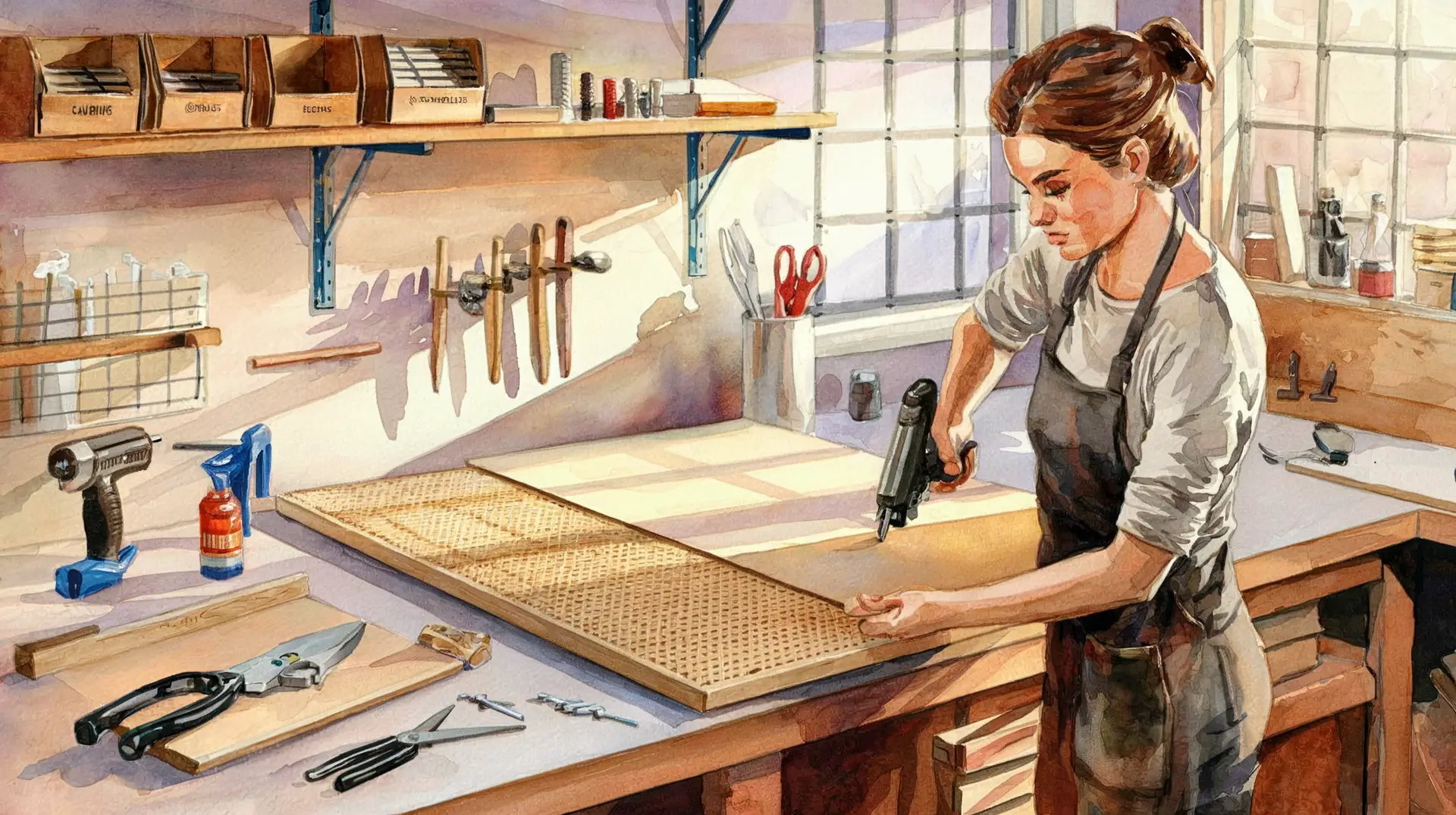
Attaching cane to flat wood is as close to a gentle introduction as you’ll get. No curves, no compound angles, no moments where you realise you’ve stapled yourself to a chair frame. This is essentially how you attach rattan to flat panels.
Common Projects:
- Cabinet door inserts
- Dresser drawer fronts
- The sides of something heavy and unloved you found in your aunt’s attic
Method:
- Soak cane (if it’s natural).
- Lay it over the opening, making sure the pattern is straight. This is surprisingly important — misaligned hexagons are the kind of thing that will haunt you quietly for years.
- Start attaching from the center of one side, then move to the opposite side and repeat. This keeps tension balanced.
- Work outward toward corners. Staple, glue, press — whichever method you’ve chosen.
- Trim excess. Add decorative trim if desired. Step back. Admire. Pretend you always knew what you were doing.
Fancy Tip: If you’re replacing a center panel in a cabinet door, you might staple the cane to the back rabbet, then cover the edge with a thin bead of molding. This creates a clean, professional look and hides the mess where you fumbled the scissors slightly. (We saw that. It’s fine.) To truly master how to attach rattan to flat panels, attention to detail is key.
Now, curves. These are the surfaces that test your planning, your patience, and your opinion of physics.
Common culprits:
- Mid-century modern chair backs
- Rounded armrests
- “Barrel-back” chairs, which sound inviting and are secretly architectural puzzles
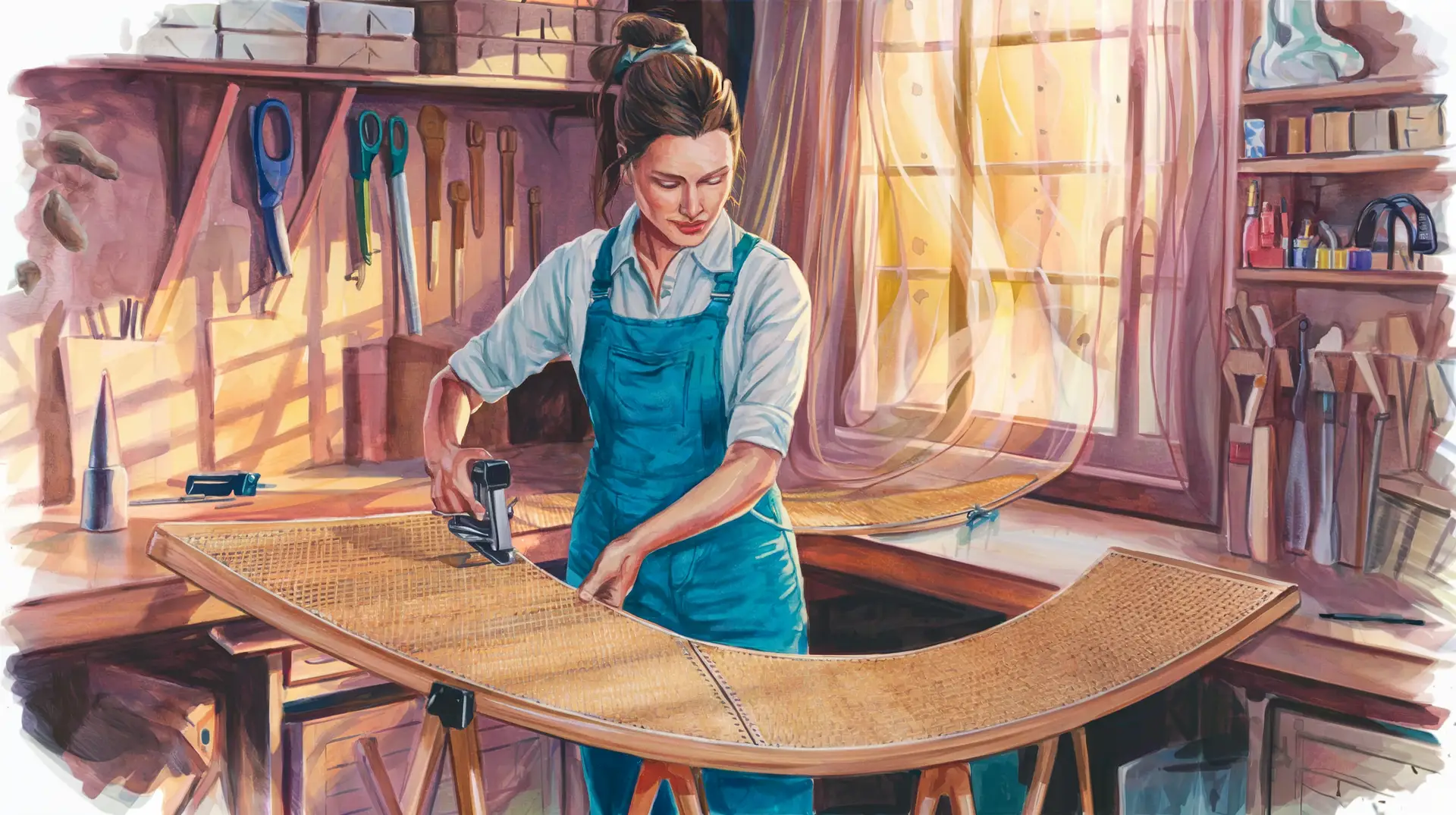
For Outward Curves (Convex):
Cane bends better than you’d expect when wet — kind of like rules at a family reunion. Start in the middle, staple or glue a bit, then stretch gently around the curve. Don’t tug like you’re trying to win a tug-of-war — just coax it along when you attach rattan to flat panels.
Relief cuts in the extra margin (not the visible area!) can help the cane sit better around the edges.
For Inward Curves (Concave):
Cane does not want to stay inside a curve. It will fight you. Hard. Here, splines and grooves are your friends. Press the wet cane into the groove and tap in the spline with glue — the same way you might gently convince a feral cat that the carrier isn’t a trap.
Clamps are essential. Also, possibly an extra set of hands. Or two. Or a helpful teenager you can bribe with snacks.
3. Large Panels and Walls — The Statement Pieces
Rattan is increasingly being used for things like:
- Accent walls
- Room dividers
- Headboards that whisper boho chic into your dreams
In these cases, think big — but also think modular. It’s often easier to mount cane onto a plywood or wood frame first, then attach that to your wall. That way, if you misalign something, you’re not explaining to your landlord why there’s glue behind the TV when you attach rattan to flat panels.
You can:
- Stretch the cane over a large wooden frame like an artist’s canvas
- Glue it onto thin plywood sheets
- Add a surrounding trim to hide the sins of alignment when you attach rattan to flat panels
Just remember: the bigger the surface, the more likely the cane is to warp as it dries — especially if it’s natural and has dreams of turning into a drum. Weight it down well while drying, or be prepared for a gentle ripple effect that makes your panel look permanently surprised.
by Uncle John | Mar 22, 2025 | The Art of Rattan & Wood
Every epic tale begins with a union. Helen of Troy had her face, Arthur had his sword, and you, dear reader, have choices. Before a single staple is fired or a drop of glue splattered with righteous intent, you must choose your players. You might wonder, what is rattan? Let’s delve into it and explore.
What Even Is Rattan?
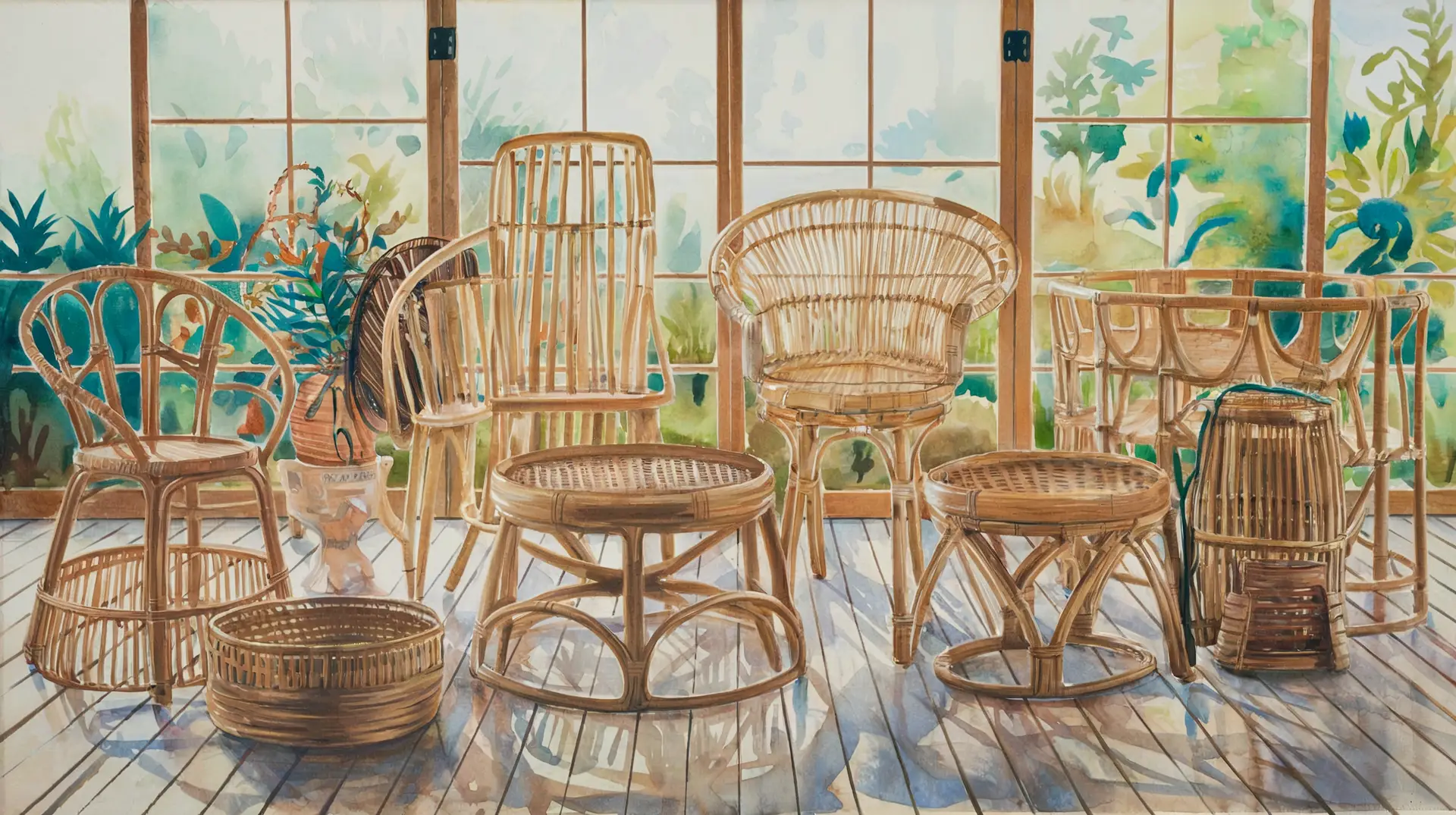
Rattan is what happens when a palm tree and a basket fall in love. It’s the vine that dreams of becoming furniture, and it’s remarkably good at it. The outer bark — known as cane — is thin, strong, and frequently seen making chair backs look like they’ve just returned from a yoga retreat.
There are two main types you’ll likely encounter:
- Pre-woven cane webbing: Comes in rolls or sheets and is ideal for the lazy-but-elegant approach. You cut it, you slap it on, you bask in its rustic charm, instantly knowing what rattan can achieve.
- Rattan strips: These are for people who enjoy weaving things through holes while questioning their life choices. Beautiful? Yes. Therapeutic? Maybe. Time-consuming? Absolutely.
Also in the mix: rattan poles, which are like the structural lumberjacks of the rattan family — less for attaching, more for holding your chair together when someone sits down too enthusiastically.
Natural vs. Synthetic: The Great Debate
Here’s the thing: natural cane is lovely. It’s biodegradable, has the aura of something your grandmother would nod approvingly at, and develops a charming patina over time — that’s furniture speak for “it goes yellow but in a good way.
But it fears moisture the way cats fear vacuum cleaners. Leave it out in the rain and it will weep gently and then begin to unravel like your willpower at 3AM, making you question what exactly rattan is capable of surviving.
Synthetic rattan, on the other hand, is made of clever resins and doesn’t care about your weather. Rain? Sun? Apocalypse? It shrugs and keeps looking stylish. It’s ideal for outdoor use or for people who suspect their houseplants are conspiring to increase humidity.
TL;DR:
- Indoor project = Natural rattan, for the soul.
- Outdoor project = Synthetic rattan, for the sanity.
Sheets vs. Strips: A Question of Time and Suffering
Most mortals use sheets of pre-woven cane. You cut it to size, attach it, and then pretend you’ve always been this handy.
Strips, on the other hand, require you to weave, bind, and lash — like furniture origami with extra judgment. Best reserved for advanced projects or when you’re trying to impress someone who owns leather-bound toolboxes.
The Wood: Your Trusty (or Treacherous) Canvas
You’d think wood is wood, wouldn’t you? But no — some types of wood behave themselves, while others split, warp, or absorb glue like a toddler absorbs chaos.
Let’s rank them:
- Hardwoods (oak, teak, birch): Loyal, stable, and excellent for structural frames. Will hold onto staples like a conspiracy theorist to a headline.
- Softwoods (pine, cedar): Easier to cut but also prone to sulking. Staples may fall out, or the wood may develop “character” under pressure. Still perfectly usable, but tread lightly.
- Plywood: Flat, stable, and perfect for panels. Just make sure it’s a decent grade — not the kind that looks like it was cobbled together by hungover beavers.
- MDF: Heavy, smooth, and a bit of a diva. Loves glue, hates water. If you’re using natural rattan (which must be soaked), either seal the MDF first or prepare for a warped panel that resembles a soggy biscuit.
And let’s not forget your existing furniture — charming, varnished relics of earlier lives. These will need sanding or stripping where the cane goes. Not everything sticks to gloss, as your high school crush may have also demonstrated.
by Uncle John | Mar 22, 2025 | The Art of Rattan & Wood
aka..( How to Bathe Your Cane and Convince the Wood It’s Ready for Commitment)
Before any rattan meets wood in holy (or slightly sticky) matrimony, there’s prep work to be done. Think of this stage as setting the table before the main course. You wouldn’t just dump spaghetti on a newspaper and call it dinner — same goes for slapping cane onto raw, unready timber.
Step 1: Sanding, Cleaning, and Making Wood Feel Pretty
If your wood has been previously varnished, painted, or generally left to gather character (read: grime), you’ll need to do a bit of smoothing and stripping. Use fine-grit sandpaper (150–220) and focus especially on the areas where glue or staples will go.
Remove any dust afterwards — use a vacuum, tack cloth, or a polite yet insistent puff of air. Dust may be small, but it is mighty when it comes to sabotaging adhesives.
Pro tip: If the wood has a glossy finish, give it a quick scuff. Glue and gloss get along about as well as cats and bubble baths.
Step 2: Soaking the Rattan (Yes, It Needs a Spa Day)
If you’re using natural rattan, it needs soaking. Warm water. Twenty to thirty minutes. Not an hour. Not overnight. Just long enough to become pleasantly pliable, like pasta that still has a bit of bite.
This soak does two things:
- Makes the rattan flexible, so you can stretch it across frames or into grooves.
- Allows it to shrink as it dries, pulling tight for a crisp, professional look — the furniture equivalent of “snapping back.”
You can soak cane in a bathtub, a bucket, or — for the enterprising — a capped length of PVC pipe. If you hear it sigh in relief as it goes in, you’ve done well.
Avoid:
- Over-soaking (leaches oils, weakens fibres)
- Using boiling water (this is rattan, not tea)
Synthetic rattan, on the other hand, is impervious to drama. No soaking. No shrinking. Just unroll it, maybe let it lie flat for a bit, and give it a gentle wipe to remove any factory dust. It’s the stoic cousin of natural cane — low maintenance, dependable, slightly smug about it.
Step 3: Cutting to Fit (Measure Twice, Panic Once)
Once your rattan is softened (or in the case of synthetics, just slightly more cooperative), it’s time to cut. Always give yourself an extra inch or two around the edges. This is not the moment for precision — it’s the moment for generosity.
Use:
- Sharp scissors for soaked cane
- A utility knife and cutting mat for dry or synthetic materials
Don’t cut right along the woven edge unless you enjoy watching beautiful patterns unravel like ancient prophecies. Keep a buffer.
Lay the rattan over your frame and do a dry fit. Does it cover the space with room to spare? Is the pattern centered, or at least not obviously trying to escape off one side? Excellent. You’re nearly ready for the big moment.
Next up is Part 3: Attachment Methods, where we explore glue, staples, nails…….
by Uncle John | Mar 22, 2025 | The Art of Rattan & Wood
(Also known as: Glue, Staples, Rattan sheets, and Other Mildly Dangerous Tools of Domestic Transformation)
So. You’ve got your wood — clean, smugly sanded — and your rattan — soaked (or unbothered, if synthetic) and obediently cut to size. Now comes the bit where it all comes together. Or potentially flies apart, depending on your grasp of adhesive behaviour and mechanical fasteners.
Fear not. We have options. And possibly a bandage or two.
Option 1: Glue — The Quiet Hero
Glue is elegant. Invisible. A sort of behind-the-scenes enabler. When used correctly, it creates a bond so tight, even your most skeptical relative won’t be able to pry your cane panel loose without the help of divine intervention or a crowbar.
The Good Stuff:
- PVA Wood Glue: Your everyday, dependable option. Bonds cane to wood nicely, dries clear (if you pick the right version), and won’t start a chemical war on your project.
- Contact Cement: Stick this on both the wood and the rattan, let it go tacky, then press together. It’s instant, it’s strong, and it leaves no room for hesitation. Not for the indecisive — once stuck, it’s there for life.
- Epoxy: Comes in two tubes and smells like commitment. Great for plastic rattan or non-porous surfaces. Less fun to clean up. Best reserved for repair jobs or “this must never come apart again” scenarios.
- Hide Glue: Traditional, smelly, water-soluble. Ideal for restorers, romantics, and those who like the idea of future repairability.
Beware:
- Yellow glue on visible cane? That’s how furniture gets called “charming” on Craigslist.
- Glue that oozes through the holes? Wipe it fast, or you’ll be picking out dots of regret with a toothpick.
Clamp or weight everything down while it dries, unless you’ve used contact cement, in which case you’ll be too busy hoping you aligned it correctly.
Option 2: Staples — Quick and Loud
Staples are the favourite of the impatient and the pragmatic. They work fast, they hold tight, and they make satisfying ka-chunk noises.
Use a staple gun (manual, electric, or pneumatic) and remember: the goal is tension, not trauma. Start in the centre of one side, then staple the opposite side while pulling the cane taut. Repeat on the other two sides. Then work your way outward like you’re stretching a canvas — or trying to convince a net to behave like upholstery.
What To Watch Out For:
- Staples that go too deep = damage.
- Staples too far apart = sag.
- Staples too close = Swiss cheese effect on your cane.
Stainless steel staples are essential for outdoor projects unless you want rust to become part of the aesthetic.
Option 3: Nails (For the Old-School Artisan Vibes)
Nails or brads are traditional and surprisingly satisfying, especially if you have a tiny hammer and a deep-seated need to feel like you’re in a workshop from 1924.
Best used when attaching trim to cover the cane edges, or if you’re feeling extra patient. Use with caution — too much force and you’ll split the wood, the cane, or your spirit.
Option 4: Hybrid Methods — The Belt & Suspenders Approach
The best way to make sure your rattan stays put, especially in high-stress spots like chair seats or drawer fronts?
Glue + Staples + Trim. The staples hold the cane while the glue cures, the glue adds strength where the staples don’t reach, and the trim hides all your secrets. It’s the holy trinity of attachment.
Another classic: Groove + Glue + Spline. If your furniture frame has a routed groove, this is your moment. Soaked cane goes in, spline (also soaked) gets tapped in on top, and together they hold like a handshake between old friends who’ve seen things.
Next Part 4: Application Techniques (Flat, Curved, and Slightly Ambitious Surfaces)?